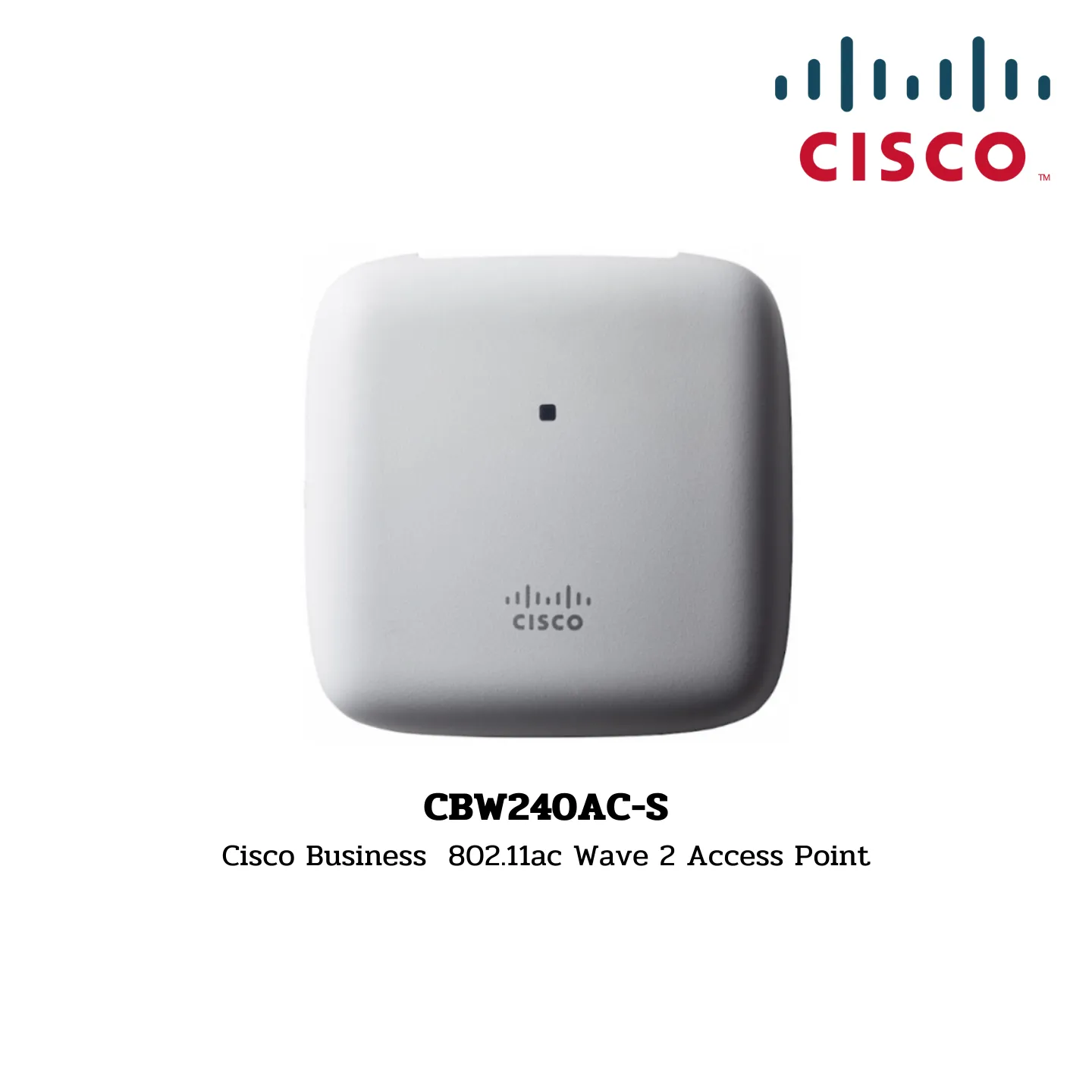
CBW240AC-S
Cisco Business 802.11ac Wave 2 Access Point
Specifications:
Authentication and Security:
- Wi-Fi Protected Access 2 (WPA2); WPA3 is coming in a future release
- 802.1X, RADIUS Authentication, Authorization, and Accounting (AAA)
- Segmentation via VLANs (up to 16)
- 802.11r and 802.11i
- Guest network can also authenticate against: Google and Facebook
Maximum Clients:
- Maximum number of associated wireless clients: 200 per Wi-Fi radio, for a total of 400 clients per access point, or 1000 in a system
Maximum Number of Access Points:
- 50 (Recommended up to 25)
Maximum Number of Mesh Extenders:
- Maximum number of associated Cisco Business mesh extenders: 25 per Access Point, up to 8 hops
802.11ac:
- 4×4 Downlink (DL) MU-MIMO with four spatial streams, up to 1733 Mbps
- 802.11ac beamforming
- 20, 40, 80 MHz channels
- Dynamic Frequency Selection (DFS)
Integrated Antenna:
- 2.4 GHz, peak gain 4 dBi, internal antenna, omnidirectional
- 5 GHz, peak gain 5 dBi, internal antenna, omnidirectional
Ethernet Ports:
- Authentication with 802.1X or MAC filtered
- Dynamic VLAN or per port
Interfaces:
- 2 x Gigabit (10/100/1000BASE-T autosensing), Power over Ethernet (PoE)
- RJ-45 console port (not functional)
- USB 2.0 (not functional)
Indicators:
- Status LED indicates boot loader status, association status, operating status, boot loader warnings, boot loader errors
Dimensions (W x L x H):
- Access point (without mounting brackets): 7 x 7 x 1.5 in
Weight:
- 0.94 lb (0.43 kg)
Powering Options:
- 802.3af/at Ethernet switch, a Cisco Business Switch with PoE is recommended
- Optional Cisco Business Power over Ethernet injector (CB-PWRINJ-xx)
Power Draw:
- 13.2W
Environmental:
- Nonoperating (storage) temperature: –22° to 158°F (–30° to 70°C)
- Nonoperating (storage) altitude test: 25˚C, 15,000 ft
- Operating temperature: 32° to 122°F (0° to 50°C)
- Operating humidity: 10% to 90% (noncondensing)
- Operating altitude test: 40˚C, 9843 ft
System Memory:
- 1 GB DRAM, 256 MB flash
Available Transmit Power Settings:
- 2.4 GHz: Up to 20 dBm
- 5 GHz: Up to 23 dBm
Maximum Number of Non-Overlapping Channels:
- 2.4 GHz:
- 802.11b/g: 20 MHz: 3
- 802.11n: 20 MHz: 3
- 5 GHz:
- 802.11a: 20 MHz: 26 FCC, 16 EU
- 802.11n: 20 MHz: 26 FCC, 16 EU; 40 MHz: 12 FCC, 7 EU
- 802.11ac: 20 MHz: 26 FCC, 16 EU; 40 MHz: 12 FCC, 7 EU; 80 MHz: 5 FCC, 3 EU
Compliance Standards:
- Safety:
- IEC 60950-1, EN 60950-1, AS/NZS 60950.1
- UL 60950-1, CAN/CSA-C22.2 No. 60950-1
- UL 2043, Class III Equipment
- EMC/EMI:
- Emissions:
- CISPR 32 (rev. 2015), EN 55032 (rev. 2012/AC:2013), EN 55032 (rev. 2015)
- EN61000-3-2 (rev. 2014), EN61000-3-3 (rev. 2013), KN61000-3-2, KN61000-3-3
- AS/NZS CISPR 32 Class B (rev. 2015), 47 CFR FCC Part 15B
- ICES-003 (rev. 2016 Issue 6, Class B), VCCI (V3), CNS (rev. 13438), KN-32, TCVN 7189 (rev. 2009)
- Immunity:
- CISPR 24 (rev. 2010), EN 55024 / EN 55035 (rev. 2010)
- Emissions and Immunity:
- EN 301 489-1 (v2.1.1 2017-02), EN 301 489-17 (v3.1.1 2017-02)
- QCVN (18:2014), KN 489-1, KN 489-17, EN 60601 (1-1:2015)
- Emissions:
- Radio:
- EN 300 328 (v2.1.1), EN 301 893 (v2.1.1), AS/NZS 4268 (rev. 2017)
- 47 CFR FCC Part 15C, 15.247, 15.407
- RSP-100, RSS-GEN, RSS-247
- China regulations: State Radio Regulation of China (SRRC)
- LP0002 (rev 2018.1.10)
- Japan Std. 33a, Std. 66, and Std. 71
- RF Safety:
- EN 50385 (rev. Aug 2002), Australian Radiation Protection and Nuclear Safety Agency (ARPANSA)
- AS/NZS 2772 (rev. 2016), EN 62209-1 (rev. 2016), EN 62209-2 (rev. 2010)
- 47 CFR Part 1.1310 and 2.1091, RSS-102
- IEEE Standards:
- IEEE 802.3, IEEE 802.3ab, IEEE 802.3af/at
- IEEE 802.11 a/b/g/n/ac, IEEE 802.11h, 802.11d
- Energy Efficiency:
- Reg. 278/2009 EuP Lot 7, Tier 1 4/27/2010, Tier 2 4/27/2010 Level V
- Reg. 1275/2008 EuP Lot 6, Tier 1 1/7/2010, Tier 2 4/27/2013. Applies to EMC Class B products
- EISA 2007, Level V
- NRCan Level V, AS/NZS 4665.2, MEPS Level V
- China Energy Conservation Program (CECP) Level V
- Security:
- 802.11i, Wi-Fi Protected Access 2 (WPA2), WAP3 (future), WPA
- 802.1X, Advanced Encryption Standards (AES)
- Extensible Authentication Protocol (EAP) Types:
- EAP-Transport Layer Security (TLS), EAP-Tunneled TLS (TTLS) or Microsoft Challenge Handshake Authentication Protocol Version 2 (MSCHAPv2)
- Protected EAP (PEAP) v0 or EAP-MSCHAPv2, EAP-Flexible Authentication via Secure Tunneling (EAP-FAST)
- PEAP v1 or EAP-Generic Token Card (GTC)
- EAP-Subscriber Identity Module (SIM)